
AISIT
Polar Flux, Global Impacts
AISIT is an interdisciplinary programme to harmonise δ18O freshwater tracer data, creating a standardised, machine-readable database of pan-Arctic δ18O and related environmental data.
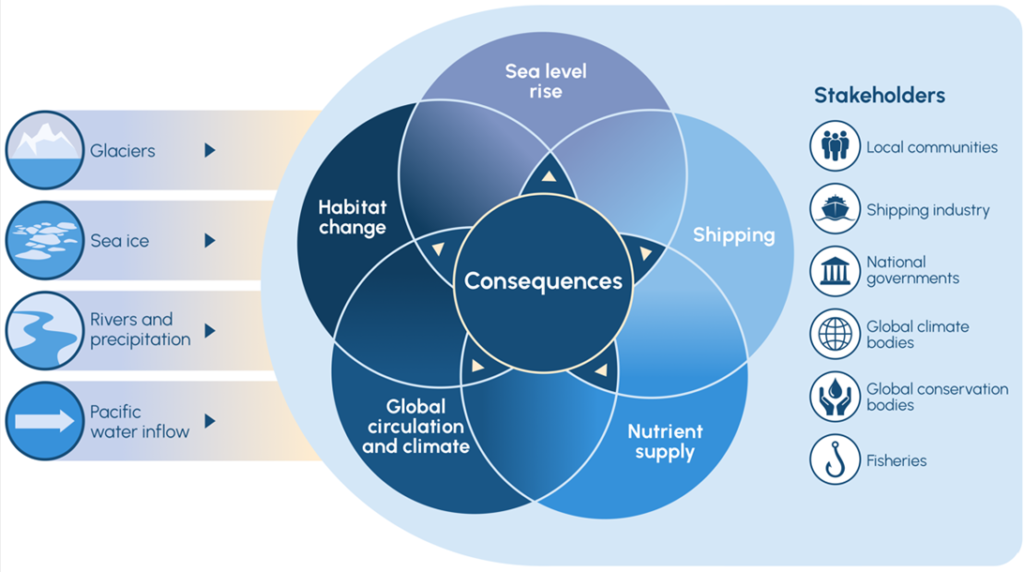
The different sources of freshwater inputs, from rivers, glaciers, and sea-ice, can be tracked through tracers such as the stable oxygen isotope δ18O, as well as certain trace metals and Rare Earth Elements. Tracing these sources of freshwater from land to ocean is a priority if the global consequences of Arctic change are to be understood.
Warming in the Arctic is leading to a significant increase in glacial meltwater discharge, large alterations in major Arctic River outputs and unprecedented levels of sea-ice retreat. This introduces large amounts of extra freshwater into the Arctic ecosystem with numerous ecological impacts, both locally and globally. Consequences and impacts include sea level rise, changes in nutrient supplies, climate and weather changes, and alterations to sea ice impacting habitats and shipping industries. The project’s stakeholders therefore extend beyond the scientific community with applicable outputs for local communities, environmental agencies, the shipping industry, fisheries and global climate agencies and global biodiversity agencies.

Funders and Participants
AISIT is funded by the Natural Environment Research Council (NERC) and the engineering Physical Sciences Research council, parts of UK Research and Innovation (UKRI).
AISIT is made up of the following three National Capability providers:
British Antarctic Survey
National Oceanography Centre
UK Centre for Ecology and Hydrology
Objectives
Work Package 1 AI-ready database construction
Work package 1 (WP1) will construct an AI-ready database which incorporates all BIOPOLE data as well as all other available δ18O Pan-Arctic data from open repositories and efforts to recover ‘hidden’ data. An accompanying data paper will be provided.
Work Package 2 δ18O Arctic Case studies
Work package 2 (WP2) will carry out two case studies to enhance the AI-readiness of the AISIT database:
Firstly, a regional study in Svalbard where there is a dense aggregation of data and a reasonable understanding of freshwater discharges comparing maps of freshwater inputs from Svalbard and distributions in the Barents Sea, using traditional and AI techniques. Secondly, a wider Pan-Arctic study to assess our ability to reconstruct the δ18O distribution across the Arctic by extracting empirical relationships with co-located measurements of other tracers (e.g. salinity) and applying them to high resolution model tracer output to give Arctic wide maps.
Work Package 3 AI driven δ18O
Building connection and collaborations between the science community and AI specialists with an AI focused competition to address a key δ18O knowledge gap with the newly developed database.
Work Package 4 Programme Management
Work package 4 (WP4) is an overarching and synthesising area of work, which will run alongside the three other work packages; it will reinforce the integration of effort across the national project partners and experts. By harmonising all Pan-arctic δ18O data, the AISIT database will leave a strong legacy to the international science community as well as helpful information for local communities, national governments, global climate and conservation bodies and the shipping industry.
Photo by Alexandro D’Elia: https://www.pexels.com/photo/majestic-snow-capped-swiss-alps-in-winter-32296110/